
Nutrition Consensus

Evidence sentiment publication

[OIL] Fats and oils

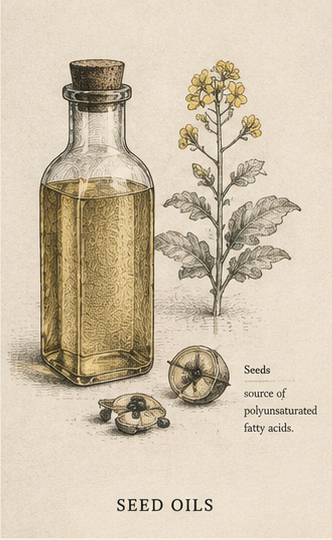
Seed oils

Last updated Jul 18, 2026 · Refresh target: weekly

Are seed oils good for you today?

Moderately favorable but contested. The ledger generally supports replacing saturated fats with polyunsaturated oils, while uncertainty remains around processing, oxidation, specific oils, and what they replace.

Additional analyst color: The discourse is more volatile than the underlying evidence.

Current score

+30

Sentiment

Moderately positive

Confidence

71 / 100

Controversy

32 / 100

Contested

Evidence items

232

30D0
90D0
1Y-5

The favorable signal is strongest in substitution studies. Treating every oil, preparation method, and dietary comparison as equivalent creates more certainty than the evidence supports.

Analyst noteConfidence reflects a broad evidence base, tempered by heterogeneous oils, endpoints, and substitution assumptions.

Last meaningful move

Oct 2022

Score move

-9

points

Driven by

Effects of oxidized soybean oil on the performance of sows and jejunum health of suckling piglets.

Journal of animal physiology and animal nutrition · Oct 12, 2022 · Negative · index impact -9

This study carried one of the largest negative public impacts added to the ledger around the move.

View study ->

Evidence sentiment index

Historical price of the seed oils thesis

Start
End
-200+20+40+60Zero line: mixed
Latest+30
SignalModerately positive
Confidence71 / 100

Axis fitted: -20 to +60. Index scale remains -100 to +100.

Latest studies

Evidence tape

Sorted by evidence availability date, newest first.

Did we miss a study?

Showing 3 of 232 studies after filter and sort.

randomized controlled trial

Effect of Dietary Linoleic Acid Intake on Eicosapentaenoic Acid Status and Lipoxygenase-Mediated Oxylipin Biosynthesis in Healthy Adults: A Randomized Controlled Trial.

Nutrients · Jun 4, 2026Open study
Direction: NeutralIndex impact 0

abstract suggests a mixed signal. BACKGROUND/OBJECTIVES: The modern Western diet (MWD) provides high linoleic acid (LA) exposure, typically contributing 6-9% of the total caloric intake.

Details and limitations

Limitations: Review full paper for confounding, population characteristics, endpoint definitions, and study design before publishing.

Evidence weight 27 / 100pubmedjournal-articlerandomized-controlled-trialdoi:10.3390/nu18111814pmid:42280457

randomized controlled trial

The effect of sesame, canola, and sesame-canola oils on oxidative stress markers in patients with type 2 diabetes: A three-way randomized crossover clinical trial.

Nutrition and health · May 26, 2026Open study
Direction: NeutralIndex impact 0

abstract suggests a mixed signal. BackgroundOxidative stress plays a critical role in the pathogenesis of chronic diseases.

Details and limitations

Limitations: Review full paper for confounding, population characteristics, endpoint definitions, and study design before publishing.

Evidence weight 27 / 100pubmedjournal-articledoi:10.1177/02601060261453506pmid:42187294

animal

Toward a Targeted Nutritional Strategy for Restoring PUFA Balance: Socio-Economic, Cultural and Ecologic Contexts, Biochemical Rationale, and a Conceptual Framework for Dietary Modulation

EuropePMC · May 18, 2026Open study
Direction: NeutralIndex impact 0

abstract suggests a mixed signal. This review outlines the health risks associated with excessive dietary intake of <i>n</i>-6 polyunsaturated fatty acids (PUFAs), particularly linoleic acid (C18:2<i>n</i>-6, LA), which is highly prevalent in the Western diet.

Details and limitations

Limitations: Review full paper for confounding, population characteristics, endpoint definitions, and study design before publishing.

Evidence weight 6 / 100europepmcreview-articlereviewdoi:10.3390/nu18101600pmid:42197060

Showing 3 of 232 studies.