
Nutrition Consensus

Evidence sentiment publication

[BEEF] Animal foods

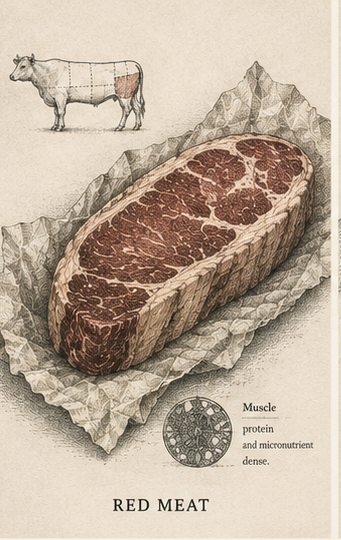
Red meat

Last updated Jul 18, 2026 · Refresh target: weekly

Is red meat good for you today?

Mostly unfavorable. The ledger leans strongly negative on long-term disease outcomes, while retaining caveats around processed versus unprocessed meat, dose, dietary context, and observational confounding.

Additional analyst color: The steak lobby submitted comments. The ledger kept its rating.

Current score

-81

Sentiment

Strongly negative

Confidence

74 / 100

Controversy

7 / 100

Settled

Evidence items

262

30D-1
90D-1
1Y-3

The harm signal is strongest for processed meat and higher habitual intake. Nutrient density remains real, but it does not erase the long-term risk evidence in the ledger.

Analyst noteConfidence reflects a large and directionally coherent evidence base, though much of it remains observational and vulnerable to residual confounding.

Last meaningful move

Sep 2020

Score move

-11

points

Driven by

Preventive Role of Diet Interventions and Dietary Factors in Type 2 Diabetes Mellitus: An Umbrella Review.

Nutrients · Sep 6, 2020 · Negative · index impact -11

This study carried one of the largest negative public impacts added to the ledger around the move.

View study ->

Evidence sentiment index

Historical price of the red meat thesis

Start
End
-100-500+50Zero line: mixed
Latest-81
SignalStrongly negative
Confidence74 / 100

Axis fitted: -100 to +50. Index scale remains -100 to +100.

Latest studies

Evidence tape

Sorted by evidence availability date, newest first.

Did we miss a study?

Showing 3 of 262 studies after filter and sort.

meta analysis

Red and processed meat consumption and the risk of pancreatic cancer: a systematic review and dose–response meta-analysis

Frontiers in Nutrition · Jul 14, 2026Open study
Direction: NegativeIndex impact -26

Systematic review + dose-response meta-analysis (16 studies, 1,959,527 participants, 8,856 pancreatic cancer cases): highest vs lowest red meat intake carried 16% higher pancreatic cancer risk (RR 1.16, 95% CI 1.02-1.31), ~10% higher per additional 100 g/day (linear). No significant association found for processed meat with pancreatic cancer.

Details and limitations

Limitations: Review full paper for confounding, population characteristics, endpoint definitions, and study design before publishing.

Evidence weight 38 / 100semanticscholarjournalarticlereviewdoi:10.3389/fnut.2026.1829536pmid:null

expert commentary

A comprehensive evaluation of epidemiological evidence on processed meat intake in relation to cancer, cardiovascular, metabolic diseases and all-cause mortality: an umbrella review

Frontiers in Public Health · Apr 28, 2026Open study
Direction: Strong negativeIndex impact -8

Umbrella review of 54 meta-analyses found processed meat associated with higher risk of multiple cancers, CVD, metabolic disorders, and all-cause mortality, with 50 g/day linked to 72% higher gastric and 17% higher colorectal cancer risk.

Details and limitations

Limitations: Certainty of evidence rated low to very low by GRADE.

Evidence weight 8 / 100semanticscholarprocessed-meatcancerumbrella-reviewdoi:10.3389/fpubh.2026.1763155pmid:null

expert commentary

TGF-β-pathway-based polygenic risk score modifies the association between red meat intake and colorectal cancer risk: Application of a novel pathway-based PRS method

Cancer Epidemiology, Biomarkers & Prevention · Apr 1, 2026Open study
Direction: NegativeIndex impact -1

Pooled CRC consortium analysis found a TGF-beta-pathway polygenic risk score significantly modifies the association between red meat intake and colorectal cancer risk.

Details and limitations

Limitations: Gene-environment mechanistic analysis; interaction effect.

Evidence weight 2 / 100semanticscholarcolorectal-cancergene-environmentdoi:10.1158/1055-9965.epi-25-1754pmid:null

Showing 3 of 262 studies.