
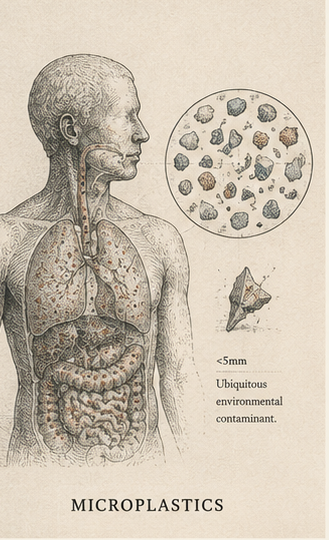
Nutrition Consensus

Evidence sentiment publication

[MPLS] Environmental exposures

Microplastics

Last updated Jul 18, 2026 · Refresh target: weekly

Are microplastics good for you today?

No. The current evidence ledger is strongly unfavorable, with no credible health-benefit case and ongoing uncertainty focused on exposure measurement, dose-response, and clinical risk size.

Additional analyst color: Placed on permanent negative watch.

Current score

-89

Sentiment

Strongly negative

Confidence

53 / 100

Controversy

3 / 100

Settled

Evidence items

208

30D0
90D0
1Y0

Placed on permanent negative watch. Analysts are searching for upside and mostly finding polymer fragments in places polymer fragments do not belong.

Analyst noteConfidence is directionally high because recent human evidence is one-sided, but exact causal pathways, exposure thresholds, and clinical risk sizes are still developing.

Last meaningful move

Oct 2019

Score move

-89

points

Driven by

Environmental exposure to microplastics: An overview on possible human health effects.

The Science of the total environment · Oct 4, 2019 · Negative · index impact 0

This study carried one of the largest negative public impacts added to the ledger around the move.

View study ->

Evidence sentiment index

Historical price of the microplastics thesis

Start
End
-100-500+50Zero line: mixed
Latest-89
SignalStrongly negative
Confidence53 / 100

Axis fitted: -100 to +50. Index scale remains -100 to +100.

Latest studies

Evidence tape

Sorted by evidence availability date, newest first.

Did we miss a study?

Showing 3 of 208 studies after filter and sort.

expert commentary

Microplastics and Nanoplastics in Human Health: From Environmental Contaminants to Internal Pollutants—A Comprehensive Review of Exposure, Bioaccumulation, Toxicity Mechanisms, and Emerging Detection Technologies

Microplastics · Jun 23, 2026Open study
Direction: NegativeIndex impact -4

Comprehensive review of micro- and nanoplastics as internal human pollutants: synthesizes evidence on ingestion (contaminated food and water the major exposure route), tissue bioaccumulation across organ systems, and toxicity mechanisms. Narrative review with mechanistic/exposure focus.

Details and limitations

Limitations: Review full paper for confounding, population characteristics, endpoint definitions, and study design before publishing.

Evidence weight 5 / 100semanticscholarjournalarticlereviewdoi:10.3390/microplastics5030131pmid:null

mechanistic

Polyethylene terephthalate and polypropylene nanoplastics toxicity in vitro: Comparative analysis of paraquat adsorption and cytotoxicity

EuropePMC · Jun 4, 2026Open study
Direction: NegativeIndex impact -9

abstract suggests a mixed signal. According to global statistics, approximately 400 million tons of plastic are produced worldwide each year, yet only about 9% is recycled.

Details and limitations

Limitations: Review full paper for confounding, population characteristics, endpoint definitions, and study design before publishing.

Evidence weight 13 / 100europepmcjournal-articledoi:10.1007/s40201-025-00970-0pmid:42253471

mechanistic

Neurotoxic Effects of Nanoplastics: Current Evidence and Mechanistic Insights

EuropePMC · Apr 30, 2026Open study
Direction: NegativeIndex impact -10

abstract suggests a unfavorable signal. Plastic products are extensively utilized in various industrial goods and consumer items.

Details and limitations

Limitations: Review full paper for confounding, population characteristics, endpoint definitions, and study design before publishing.

Evidence weight 15 / 100europepmcreview-articlereviewdoi:10.3390/toxics14050387pmid:42198512

Showing 3 of 208 studies.